OUR COMMUNITY FORESTRY
- About Us
- OUR Team
- Equity Statement
- …
- About Us
- OUR Team
- Equity Statement
OUR COMMUNITY FORESTRY
- About Us
- OUR Team
- Equity Statement
- …
- About Us
- OUR Team
- Equity Statement
Grants Pass Canopy Collaborative
About the Program:
The Grants Pass Canopy Collaborative is bringing 150 large climate-resilient shade trees to low canopy neighborhoods in support of environmental equity, shade, and beauty throughout the city. Made possible through a grant from the Oregon Department of Land Conservation and Development (DLCD) Community Green Infrastructure program, this initiative is a collaboration between OUR Community Forestry, Grants Pass Parks and Recreation Department, and Project Youth+ Career Build Program.
Beginning fall 2026, OUR Community Forestry and a team of workforce development interns from Project Youth+ will lead community tree planting events at planting sites in high-need neighborhoods identified through DLCD’s Green Infrastructure Improvement Zone map. The internship program provides young adults from the Grants Pass community hands-on experience in urban forestry, from community engagement to planting and tree care, building pathways into green careers while investing directly in their own neighborhoods.
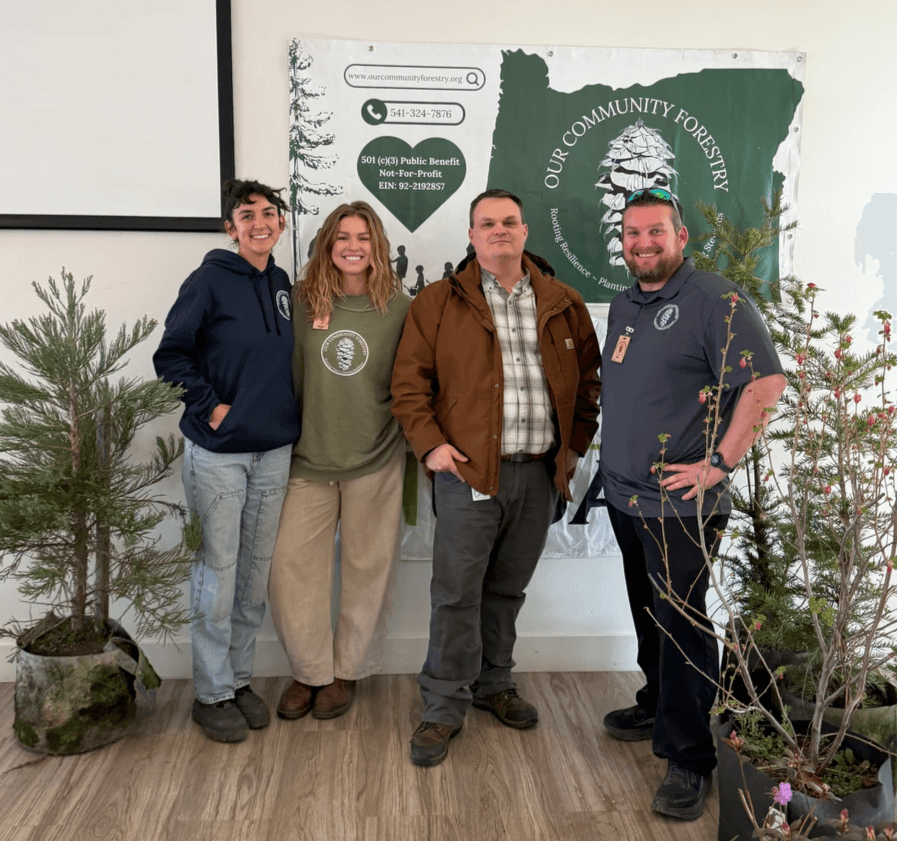
OURCF team members Abby, Megan, and Mike with Grants Pass Parks Superintent Josh Hopkins.
All trees are sourced through OURCF’s Trees for All Oregonians program. These trees are climate-adapted species grown by Plant Oregon nursery with funding from the Oregon Department of Forestry and made available at heavily subsidized cost specifically to support planting in underserved communities across the state. To ensure long-term success, every tree planted through this project will receive three years of professional arborist maintenance, including structural pruning, health assessments, and care by OURCF’s team of ISA-certified arborists, addressing one of the most common reasons urban tree plantings fail to reach canopy maturity.
Research by American Forests shows that low-income communities have, on average, 26% less tree canopy than wealthier neighborhoods in the same city, a disparity with real consequences. Trees reduce surface temperatures by up to 10°F, filter air pollutants and stormwater runoff, support mental health and community wellbeing, increase property values, and make streets more walkable and economically vibrant. In a region where summer heat continues to intensify, equitable access to urban canopy is not just an environmental issue, it's a matter of public health and community resilience.
To stay informed about updates to this project, subscribe to our monthly newsletter.

Subscribe to Our Newsletter
PO Box 102, Talent, OR 97540